Monday, January 05, 2015

2014 25th Anniversary Trip Part 9: The Panama Canal


The Panama Canal
Ah, the post I've been waiting for, the whole reason why we took this cruise, other then the fact it was our 25th wedding anniversary, the Panama Canal. It turned out to be a VERY long day!!!

We woke up at 5:30am, as we were scheduled to transit the canal starting at 6am! Right at 6 we crossed over the bar from the Caribbean to enter the canal area. Soon the tugs boast came out to meet us, and it was barely light out.

The new Canal Lock doors for Gatun
Nearly the entire ship was on the outside and forward deck to watch us slowly inch towards the first set of locks at Gatun. It was pretty crowded. The crew had cornered off an area to allow the ship photographer to take photos of passengers as we went thru the canal, which we took advantage of.

On the ship's PA they gave a history of the canal as well as pointing out what was going on  step-by-step, including when the Ship's captain was no longer in charge as a canal Pilot was on the bridge. This becomes an important fact later in our journey.
The old French Canal

We saw the remains of the original French attempt to build the canal to the ships right. Even current PanamaMax ships have nor hope trying to go thru the original French size canal. On the ships left was the making of the new set of locks which are 50% bigger then the current locks. The new lock doors were sitting at the entrance waiting for their placement. They were HUGE! After listening to our guide in Panama yesterday, as seeing the status of construction, I think 2018~2020 is realistic as to when the new locks will be finished, not 2014/15 which was the original plan.
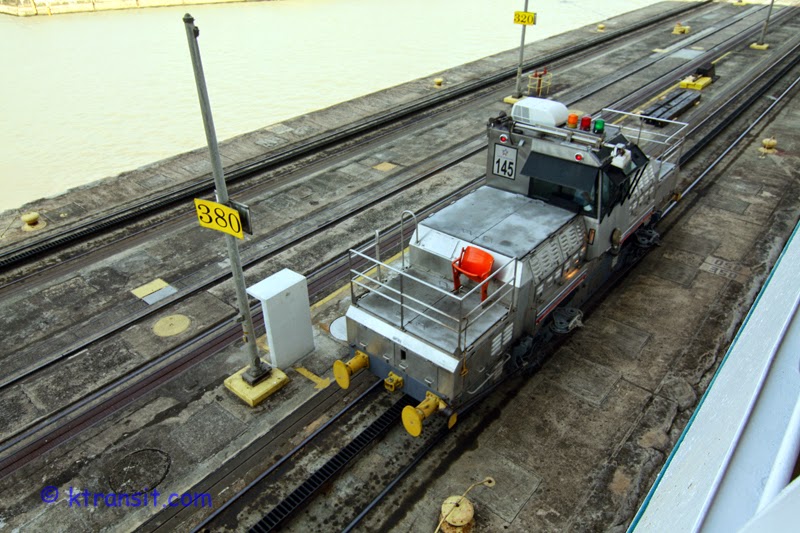
A "Mule"

Soon our ship was connected to the "Mules" at the first set of Gatun Locks. Mules are electric locomotives that run along the side walls of the locks that keep the ship centered as it moves thru the locks. The mules so not pull/push the ship. The cables are kept taut or slack to ensure the ship never hits the lock walls. They are powerful little beasts. Their electric power comes from a slot between the rails, much like streetcars in Washington DC and New York City did back in the day.

Soon we were in the first lock. Once in the lock with the doors closed, it takes about 8 minutes for our ship to rise enough to enter the second lock. Gatun has 3 sets of locks before allowing us entry into Gatun lake. Each lock requires the addition or release of over 26 million gallons of water. Luckily they were ships going up and down on either side of the canal, so ultimate "only" 26M gallons of fresh water from Gatun Lake is washed out to sea for every ship that transits the canal.
Entering Gatun Lake

By around 10~11am were started our transit across Gatun Lake and into the Culebra cut. This was a very slow transit with ships everywhere. Gatun Lake is the source for water fro the canal. Luckily it rains a lot in Panama to be able to have this huge man-made lake. But Panama does have a dry season, where they were in the middle of, so the lake was lower than normal. This would prove important later on in our journey

As stated  earlier, the French had tried to build a canal before the Americans. But the French plan to to have a level canal. There was thought that the Pacific and Caribbean had different water levels, but that is plain false. What is true, is the Pacific side has tidal influences which can affect the water height by up to 18 feet depending on the time of day. The french plan did not work, and with Malaria, it made it impossible. Soon the Americans took over and decided to go over the mountains. 

Gatun Lake control house, finished in 1913,
the canal opened in 1914
The canal opened in 1914 with 3 sets of locks on the Caribbean, and 1 set of one, plus another set of 2 locks on the Pacific side. The total canal length is about 48 miles. The canal overshadowed the first American Transcontinental Railroad, the Panama Railroad (not the UP/CP line in North America), but the Panama Railroad is still an important lifeline in Panama. The locks do not require any pumps. The only energy used in canal operations is the opening of the lock doors. Water is strictly gravity fed thru gate valves. Very efficient, just with a huge water loss. The new set of lock intends to be able to recycle 50% of the water, which is good since the new locks will require more water. But again, gravity will be it friend, with the addition of water storage. An interesting fact about the canal, is when you head from the Caribbean to the Pacific, when you exit on the Pacific side, you will be further east then when you started in the Caribbean. Bizarre, yes, but when you look at a map, most of the transit you are heading more north/south then east/west. So geography over-rules your common sense.... Check it out...

New bridge over the Culebra Cut
After going thru the tight Culebra cut, we enter the Pedro Miguel lock. It is single set of locks that drops the ship from Gatun Lake into Lake Miraflores. This is where the dry season, and that the Canal Pilot is in charge becomes important.

The ship connected to the mules again, just like at Gatun. We entered the singe lock with out fan fare and soon we were dropping about 31 feet. The the forward lock door opens and we slowly head into Lake Miraflores. 


The "notch" in the control house roof was caused by our ship
As the side "fly" bridge was starting to go past the Control house, something happened with one of the tensioning cables from the Mules that allowed the ship to sway towards the building. The Fly bridge is wider then the ship itself, then there was a crashing sound. The fly bridge was crunching the roof of the Pedro Miguel control house. Roofing tiles came crashing onto the rails for the mules below. However the ship never stopped moving. Stopping would cost more money. Ground workers quickly removed the tile pieces to allow the locomotives to pass. Later the Ships Captain explained, that yes he was on the bridge, but the Canal Pilot was in full charge of the ship, including the tension cables on the Mules. It sounds like there were a variety of factors that lead to the incident.
1) The fly bridges on the Legend of the Seas, had been made a little wider during a recent retrofit since the ship had been thru the canal last.
2) Lake Miraflores was lower then normal due to the dry season.
3) One of the cables on the mules was allowed to go slack when ti shouldn't have. 
Miraflores Visitor's center as seen from our ship.
We saw the canal the day prior from the visitor's center.

All 3 factors worked together to allow the roof of the control house to be damaged. However, Royal Caribbean International, or the Captain of the Legend of the Seas, will not be held accountable, since the Canal Pilot was in charge. The Captain seems to smile when he said that, and maybe he should charge the canal to fix the paint scratch on his ship :).

After that excitement we were soon coming up on the last set of lock, Miraflores. These 2 locks till lower the ship from Lake Miraflores into the channel that takes us to the Pacific Ocean. There was not excitement like the last set of locks, but a send of accomplishment was building on the ship. Before long we were on the Pacific side and by 6pm we were crossing under the Americas Bridge and heading to sea.
The America Bridge and our exit from the canal

In total is took us 12 hours to transit the canal from end-to-end. I walked about 5 miles on board ship watching its progress. Admiring the engineering of the 1914 canal and seeing the building of a 21st century canal was awe inspiring, and exhausting. Royal Caribbean paid about $300K in tolls for us to transit the canal, with the use of pilots and tugs and Mules. The Bucket list item complete!!!

For the evening, I believe we skipped the night's entertainment, but did eat sushi at the Izumi Grill for dinner. Soon we were in bed for the night. It was hard to believe we still had 8 days left on board ship....


Gatun Locks looking towards the Caribbean


A bit taken out of the Pedro Miguel Control House
Roof tile on the trackway
The new Gatun Locks under construction
The canal
Railroad crane for canal maintenance


Looking back from the Pedro Miguel lock
Note the gap between the ship and the canal wall...
Dredge in Culebra Cut preparing it for the larger ships

Gatun Locks
 
Canal Tug

Gatun Lake

Culebra Cut


Railroad Crane


Tuesday, December 30, 2014

2014 25th Anniversary Trip Part 8: Colon & Panama City

Welcome to part 8 of this series, getting very close to the whole purpose of this cruise, the Panama Canal. Today our ship docked on the Caribbean side of the canal at Colon.

The Monarch
Our ship arrived at Colon first thing the morning. We got to see a former RCI ship, the Monarch of the Seas, now simply call The Monarch and owned by Pullmur. It is a smaller ship than the Legend that RCI let got a couple of years prior.

We had booked a non-cruise ship shore excursion, which is considered risky by most, and believe me I was concerned. The name of the tour group is My Friend Mario, or Almiza Tours. We were given very detailed directions on where to meet the tour guide with a warning that other folks may try to say they our tour guide, but in reality, they may not be. When we walked off the ship we headed straight to the meeting point, and we were accosted by several other tour operators along the way. But we found our Tour Guide right at the bottom of the escalator just as promised. Apparently this was Mario # 3, and we were to be with Mario # 2 (there are at least 4 Marios that work for this company). He said we had to wait since they were waiting for others to come off the cruise ship as well, and directed us to the gift shops nearby to wait.

Balboa Statue
About 20 minutes later we were all lead down to waiting mini-buses. But Cyn and I were told to wait as they were loading up 2 other tours first. We then found out that Cyn and I were the only 2 people who signed up for the Panama City and Canal tour. So we were going to ride in the back of Mario #2's taxi for a personal tour. This had me a little more nervous, as I figured the rates we to pay I would have guessed would require more people.

We got into the car and Mario started driving first to a gas station to fill up. Colon is a very run down and in fact very scary city. Very dirty and just felt very uncomfortable, and this from an ex-New Yorker. Luckily our tour had nothing to do with Colon... Soon enough we were on our way. First Mario started heading to the Gatun locks, but decided against it as all the cruise ship buses were heading that way, so change of plan and we headed straight to Panama City.  

Church at the main square in San Felipe
Mario, while driving, gave us a great history of Panama, including what fruits grow there and the weather. He very much stressed the importance of the Canal and Balboa in the development of Panama. The only scary part is he was pointing out features on laminated maps to us while driving at 60mph... Balboa is such an influence in Panama, that many roads in Panama City are called Balboa, the port is called Balboa, there is Balboa Statue, and the currency is called Balboa's. The US Dollar is directly interchangeable with Balboas in a 1:1 ratio and both are widely accepted  in Panama.

Modern Panama City from Ancon Hill
Soon enough we were in Panama City which is a traffic nightmare. We drove by an elevated station of the Panama Metro, which was not quite opened yet (it should have been open the month before, but did not open until May). We went by the ruins of the original Panama City, comparing it to the modern Panama City, then headed to the old town (San Felipe) for lunch. We ate a nice cafe/hotel. We picked up lunch for Mario, as thus far he was doing a great job of giving us a personal tour. We then walked around the old town. I got to see tracks in the streets of the old streetcar line in town. He pointed out the differences between French and Spanish influenced homes and old churches. We saw cruise ship tour groups walking around, and Cyn and I felt confident we were getting a much better tour.We walked along the sea wall and stopped inside an air conditioned church.
Panama City from Ancon Hill

Our next stop was going to the top of Ancon hill, which was part of the old American military base. We got a beautiful view of Panama City and the Canal. I then checked to see fi a cache was nearby, and yes there was about 250 ft from where I was. So while my wife walked around the hill with Mario, I quickly side-tracked to find the cache. It was a quick find. Caches hides here have to be weather proofed due to all the rain they get. The cache was double bagged, as well as the log...
Miraflores Locks

After Ancon hill, Mario took us to the Miraflores Locks visitor center. We spent a good hour at the center. Mario got us brochures that the cruise ship groups were giving out, which was cool. We watched sail boats as well as a large freighter go thru the locks.

It was starting to get dark, so we headed back to Colon. Again seeing Colon, I have no interest and touring that city, but Panama City was wonderful! We got back in plenty time to do some shopping at the port. We paid Mario for the tour (Which was less then half the cost of the Cruise ship tour to Panama City), plus a pretty hefty tip for the great job he did. I would recommend My Friend Mario tour anytime!

On board ship we ate in the main dining room and saw the evening entertainment, Glenn Smith, pianist/entertainer who was fun to watch...

Next stop: Transit the Panama Canal!! 
Sail boats going thru MiraFlores Locks
Old Streetcar tracks in San Felipe
San Felipe
San Felipe

San Felipe
Americas Bridge
San Felipe

Sunday, December 28, 2014

2014 25th Anniversary Trip Part 7: Cartegena, Columbia

Welcome to Part 7 of our anniversary trip. Today was our first Port-of-Call on the ship, Cartegena, Columbia.

We booked a city tour which included some entertainment and a beverage. We boarded our mini-bus on the dock right by the ship. Our driver was missing some fingers, but seemed to be able to drive around okay. Cartegena maybe a historic city, but it is not a very pretty one. Very pushy hawkers would flood the bus doors every time we got out to look around. Cyn and I avoided them like the plague. We did go up tot he old church on top of the hill overlooking the city which was quite nice. We saw the ruins of an old Spanish fort. We went into the market place, with pushy vendors.

Entertainment
Our break was at a small cafe along the waterfront. Local dancers did a nice routine for the the cruise ship tourist. I got to try the local Columbia beer, which wasn't bad. We then went on a walking tour thru the old city whcih was pretty neat before be shuffled onto the mini-bus to head back (A bit rushed). 

I did get to see the makings of what is to be a Bus Rapid Transit System. There were stations in the middle of some streets. In doing some
Columbian Beer
research, that BRT has been under on/off construction for some time. The traffic in the city is horrendous, and filled with Jitney buses. A full fledged transit system is needed, but who knows if it will ever get finished. 


Once back at the dock, I went out to grab one geocache that was right by the cruise ships. The coords on the GC page were way off, but reading the logs made finding this cache easy, and my first, and only cache in Columbia.

I believe we skipped the evening show that evening and just ate in the main dining room.

Spanish fort


Old Church courtyard

City view
Cruise Ship Mini-buses everywhere

Cruise Ship Port

Future (maybe?) BRT Station

This guy wanted money for photos to be taken, I got him while on the bus...

Old Town, reminds me of New Orleans

Old Town
New Cartegena

Old Tpow